
The Song That Changed Christmas Forever
Irving Berlin’s ‘White Christmas’ shaped the holiday and its music
Although both the classic 1942 movie musical and the new Broadway production of “Holiday Inn” (which opens on Oct. 6) are crammed with spectacular production numbers involving entire chorus lines and elaborate sets and costumes, the uncontested highlight is the quietest song in the score. Near the end of Act 1, the singer and songwriter portrayed by Bing Crosby in the film—and now by Bryce Pinkham on stage—sits down at the piano and plays his newest composition, “White Christmas,” for his leading lady. That brief moment in a Hollywood musical, released eight months into World War II, led to a sea-change in American culture.
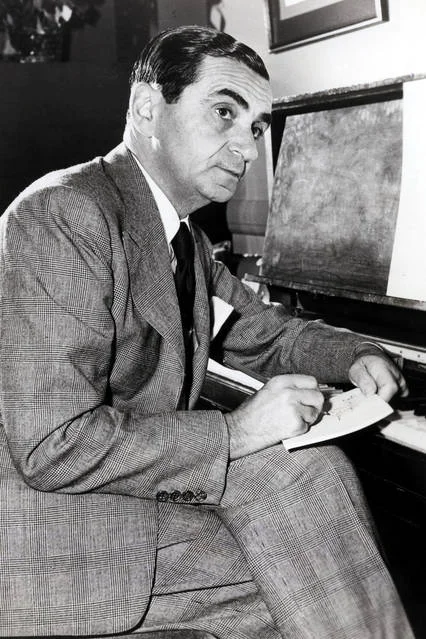
Irving Berlin PHOTO: REDFERNS
The modern celebration of Christmas scarcely existed at all before the war: There was only one classic Christmas song written in the 1930s (“Santa Claus Is Coming to Town”) and only one major Hollywood Christmas movie (the 1938 adaptation of Dickens’s “A Christmas Carol”). The prevailing showbiz wisdom was that it made little sense to invest money and energy in a product that was salable for only a very short window each year.
Legend has it that composer Irving Berlin was in Hollywood working on a movie, and missing his family in New York, when he conceived of “White Christmas.” And the song’s verse, which Berlin himself later sought to suppress and removed from nearly all publications of the sheet music, tells of an easterner stuck in “Beverly Hills, L.A.,” where the shining sun and the swaying “orange and palm trees” make him nostalgic for a white Christmas, just like the ones he used to know.
According to historian Jody Rosen in his authoritative “White Christmas: The Story of an American Song,” Berlin’s first idea was to write a comedy song, deriving laughs from the contrast between sunny California and a traditional Northeastern winter scene. He initially wanted to use it in a stage musical, but unlike the show about to open at Studio 54, this was to be a revue—the customary vehicle for witty songs and satirical sketches—rather than a modern “book” musical.
But from the day that Berlin first brought “White Christmas” into his office in January 1940, it was clear that this was no novelty number. There’s an emotional resonance to the song not found in the likes of “Jingle Bells.” This bittersweet quality is likely connected, as Mr. Rosen notes, to the death of Berlin’s only son, Irving Jr., as an infant on Dec. 25, 1928.
The composer’s new idea was to place the song in the middle of a movie about an inn that doubled as a nightclub and presented songs for each of the major holidays. At the start of the war, both the song and the film “Holiday Inn” were blockbusters. It’s no coincidence that Berlin perfectly captured the zeitgeist—the situation in Europe had long been on his mind by then—and the song’s first audience comprised soldiers and those on the home front, who embraced it as a prayer for peace.
Yet, prescient as he was, Berlin couldn’t have predicted that his song would open the floodgates to Christmas music, a deluge that continues unabated. “White Christmas” arrived just in time for the development of the long-playing record and television, the two mediums that virtually invented Christmas as a commercial commodity. Bing Crosby’s record is still recognized as the most successful single of all time and, more importantly, changed the way we think about holidays. As Mr. Rosen notes, in its wake rabbis and Christian leaders alike began to encourage all Americans to celebrate this time of year as a secular holiday, one which members of all faiths could participate in.
The song later got a movie of its own, the 1954 “White Christmas,” for which Paramount Pictures wisely brought back Crosby but otherwise trashed what worked so well in “Holiday Inn.” In the eponymous film, “White Christmas” is staged like a big gaudy production number in an exceptionally tacky TV special.
Remarkably, the lyrics to “White Christmas” evoke neither Jesus nor Santa Claus, and promise neither salvation nor choo-choo trains. Rather, it created its own holiday mythology with itself at the center as a hymn for peace, love and family. Thankfully, the producers of the current “Holiday Inn,” unlike those of the 1954 “White Christmas,” are smart enough to trust that.
Mr. Friedwald writes about music and popular culture for the Journal.
Original Article Courtesy of The Wall Street Journal and Will Friedwald.


